Back to the Basics: Digital Fundraising—SEO
Back to the Basics: Digital Fundraising, Part 1
April 28, 2026
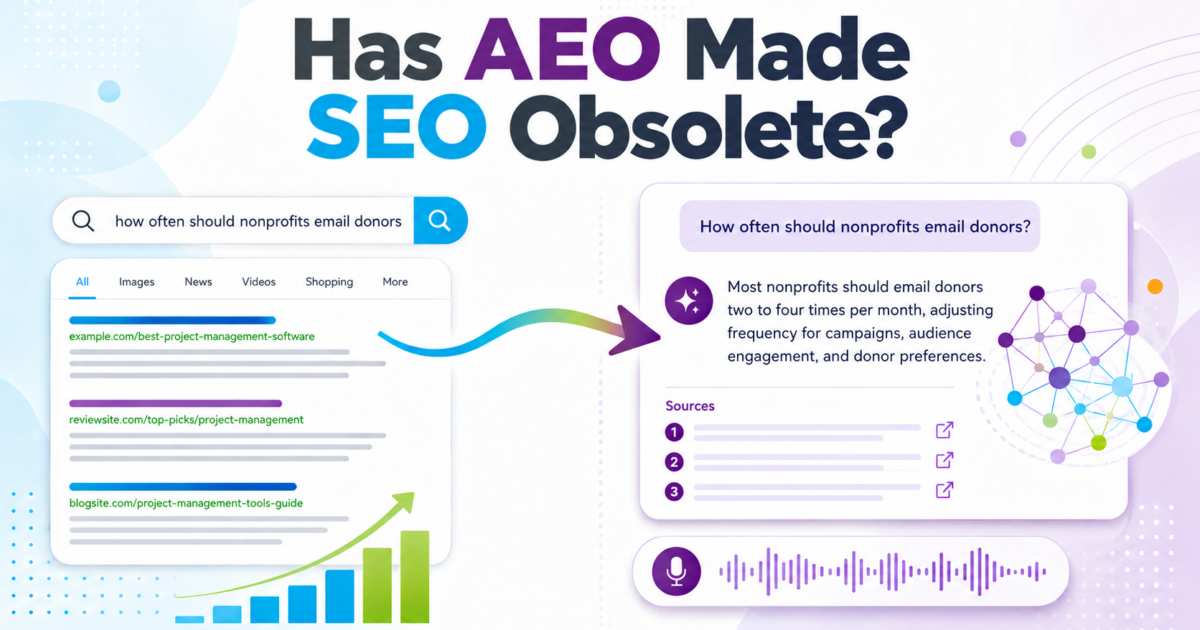
Has AEO Made SEO Obsolete?
September 1, 2026
No Ad Budget? How to Make Your Nonprofit Findable Anyway
Organic visibility costs time and effort, not dollars. Yet for most nonprofits, it remains one of the most underutilized levers available.
The missed opportunity isn’t small. When someone types “food bank near me” or “how to help Ukrainian refugees” or “environmental nonprofits I can trust,” search engines are making real-time decisions about which organizations to surface. Whether yours appears in those results shapes your ability to recruit donors, volunteers, and advocates you haven’t met yet.
And here’s the part that changes everything: those decisions are increasingly being made not just by algorithms, but by AI.
SEO Has Changed and Most Nonprofits Haven’t Caught Up
For years, SEO meant stuffing the right keywords onto a page and hoping for a high ranking. That era is over.
Today, AI-powered search features like Google’s AI Overviews are reshaping how results are delivered. Instead of a list of ten blue links, users increasingly get a synthesized answer at the top of the page pulled directly from sources that search engines deem credible, clear, and well-structured. If your content doesn’t meet that bar, it won’t just rank lower. It may not appear at all.
This isn’t a reason to panic. It’s a reason to refocus. AI-era search rewards what good mission-driven content should already be doing: explaining your work clearly, answering real questions your supporters have, and demonstrating that you are a trustworthy source on the issues you care about.
The Four Things That Actually Move the Needle on SEO
- Know What Your Audience Is Actually Searching For
Before you optimize a single page, you need to understand the language your audience uses, not the language your organization uses internally.
Your supporters aren’t searching for “capacity-building initiatives for under-resourced youth populations.” They’re searching for “after-school programs in [city]” or “how to help kids in low-income schools.” There’s a meaningful difference, and it matters enormously for your visibility.
Start with free tools like Google Search Console (which shows you what searches are already bringing people to your site) or Google’s own autocomplete and “People Also Ask” features. Look for the questions your audience is asking and make sure your content answers them directly, in plain language.
The action: Identify three to five core topics your organization owns, the issues, populations, or geographies you serve, and build content around the questions real people ask about those topics.
- Create Content That Earns Trust, Not Just Traffic
Ranking well is no longer just about keywords on a page. Search engines, and especially AI systems, are evaluating whether your content demonstrates expertise, experience, authority, and trustworthiness, a framework Google has made explicit in its quality guidelines.
For nonprofits, this is actually an advantage. You have subject matter credibility that generic content farms don’t. A food bank writing about hunger in its community has real authority. A legal aid organization explaining tenant rights has genuine expertise. The challenge is making sure that the expertise shows up clearly in your content, and not buried under vague mission language.
Name your credentials, cite your sources, include real data and outcomes, and write as the subject matter expert (because you are!) It also means keeping your website’s “About” and leadership pages accurate and complete. Search engines use those signals, too.
The action: Audit your top five pages. Would a first-time visitor immediately understand who you are, what you do, and why you’re the right source? If not, that’s your starting point.
- Structure Your Content So Both Humans and Machines Can Follow It
Clear structure isn’t just good writing practice. It’s a technical signal that helps search engines understand and reveal your content.
Use descriptive headings that reflect the actual questions being answered. Think of headings like the outline of a term paper. The H1 is your page’s main title, there should only be one, and it tells everyone (and every search engine) what the whole page is about. H2s are your section headers, the chapter titles that break the content into digestible chunks. H3s go one level deeper, like sub-points under a section. The goal is a logical hierarchy that lets someone skim the page and immediately understand its structure. Search engines read that same hierarchy when deciding how to categorize and show your content.
For organizations ready to go a step further: structured data markup (sometimes called schema) is code you can add to your website that helps search engines explicitly understand your content, whether it’s an event, a FAQ, an article, or an organization profile. It’s one of the clearest signals you can send to AI-powered search about your content.
The action: Pick your most important landing page. Check that it has a clear H1 title, two or three descriptive subheadings, and a meta description that would make someone click. Those basics alone put you ahead of most.
- Make Sure the Technical Foundation Isn’t Working Against You
Even great content won’t rank well if your site is slow, broken, or hard for search engines to crawl. You don’t need to be a developer to address the most common issues, but you do need to be aware of the tech.
Run your site through Google’s free PageSpeed Insights tool. Check for broken links. Make sure your site is mobile-friendly and loads quickly. Google uses page experience as a ranking factor, and most nonprofit supporters are finding you on their phones. If you use a CMS like WordPress, keep it updated and avoid plugins that slow your load time unnecessarily.
The action: Install Google Search Console if you haven’t already. It’s free, it’s authoritative, and it will tell you exactly where your site has technical issues that are hurting your visibility.
The Bigger Picture
SEO isn’t a one-time project. It’s an ongoing necessity. Organizations that win at organic search are consistently creating content that serves their audience, maintaining a technically sound website, and building the kind of credibility that earns links and mentions from other trusted sources over time.
The investment is real, but the return compounds. A well-optimized page can bring in qualified visitors for months or years, without any ad spend behind it.