Are you making these 6 fundraising moves in 2026?

Welcome, Jade Nguyen Swanson, our new Director of Business Development
January 9, 2026
Back to the Basics: Digital Fundraising, Part 1
April 28, 2026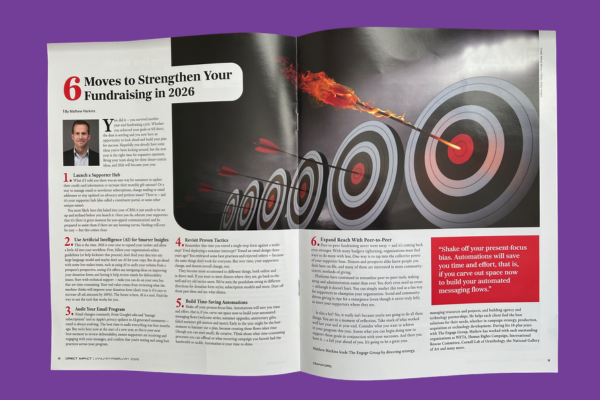
Fundraising is evolving quickly, but the principles that drive meaningful donor engagement remain timeless. In the January/February issue of Direct Impact, DMAW’s member publication, Mathew Harkins of The Engage Group outlines six practical strategies to help nonprofit teams strengthen performance in today’s increasingly complex environment. His insights bridge proven fundraising fundamentals with emerging technologies, including smarter systems and AI-driven approaches that help teams work more efficiently and effectively.
We are pleased to share the full article below, originally published in DMAW’s Direct Impact.
6 Moves to Strengthen Your Fundraising In 2026
You did it — you survived another year-end fundraising cycle. Whether you achieved your goals or fell short, the dust is settling and you now have an opportunity to look ahead and build your plan for success. Hopefully you already have some ideas you’ve been kicking around, but the new year is the right time for expansive openness. Bring your team along for these donor-centric ideas, and 2026 will become your year.
Launch a Supporter Hub
What if I told you there was an easy way for sustainers to update their credit card information or increase their monthly gift amount? Or a way to manage email or newsletter subscriptions, change mailing or email addresses or stay updated on advocacy and petition issues? There is — and it’s your supporter hub (also called a constituent portal, or some other unique name).
You most likely have this baked into your eCRM; it just needs to be set up and stylized before you launch it. Once you do, educate your supporters that it’s there (a great moment for non-appeal communication) and be prepared to assist them if there are any learning curves. Nothing will ever be easy — but this comes close.
Use Artificial Intelligence (AI) for Smarter Insights
This is the time. 2026 is your year to expand your toolset and allow a little AI into your workflow. First, follow your organization’s ethics guidelines (or help kickstart that process), don’t feed your data into any large language model and maybe don’t use AI for your copy. But do go ahead with some low-stakes items, such as using AI to audit your website from a prospect’s perspective, seeing if it offers any intriguing ideas on improving your donation forms and having it help review emails for deliverability issues. Start with technical support — tasks you can do on your own but that are time-consuming. Your real value comes from reviewing what the machine thinks will improve your donation form (don’t trust it if it says to increase all ask amounts by 100%). The future is here. AI is a tool. Find the way to use the tool that works for you.
Audit Your Email Program
Email changes constantly. From Google’s tabs and “manage subscriptions” tool to Apple’s privacy updates to AI-generated summaries — email is always evolving. The best time to audit everything was four months ago. But we’re here now at the start of a new year, so this is your next best moment to review deliverability, ensure supporters are receiving and engaging with your messages, and confirm that you’re testing and using best practices across your program.
Revisit Proven Tactics
Remember that time you tested a single-step form against a multi-step? Tried deploying a sustainer intercept? Tested an email design three years ago? You embraced some best practices and rejected others — because the same things don’t work for everyone. But over time, your supporters change, and donors overall change, too.
They become more accustomed to different things, both online and in direct mail. If you want to meet donors where they are, go back to the well and try old tactics anew. We’ve seen the pendulum swing in different directions for donation form styles, subscription models and more. Dust off those past ideas and see what shines.
Shake off your present-focus bias. Automations will save you time and effort, that is, if you carve out space now to build your automated messaging flows
Build Time-Saving Automations
Shake off your present-focus bias. Automations will save you time and effort, that is, if you carve out space now to build your automated messaging flows (welcome series, sustainer upgrades, anniversary gifts, failed sustainer gift notices and more). Early in the year might be the best moment to hammer out a plan, because creating these flows takes time (though you can start small). Be creative. Think about what time-consuming processes you can offload or what recurring campaign you haven’t had the bandwidth to tackle. Automation is your time to shine.
Expand Reach With Peer-to-Peer
Peer-to-peer fundraising never went away — and it’s coming back even stronger. With many budgets tightening, organizations must find ways to do more with less. One way is to tap into the collective power of your supporter base. Donors and prospects alike know people you don’t have on file, and many of them are interested in more community-centric methods of giving.
Platforms have continued to streamline peer-to-peer tools, making setup and administration easier than ever. You don’t even need an event — although it doesn’t hurt. You can simply market this tool as a fun way for supporters to champion your organization. Social and community-driven giving is ripe for a resurgence (even though it never truly left), so meet your supporters where they are.
Is this a lot? No, it really isn’t because you’re not going to do all these things. You are in a moment of reflection. Take stock of what worked well last year and at year-end. Consider what you want to achieve in your program this year. Assess what you can begin doing now to support those goals in conjunction with your successes. And there you have it — a full year ahead of you. It’s going to be a great year.
Mathew Harkins leads The Engage Group by directing strategy, managing resources and projects, and building agency and technology partnerships. He helps each client find the best solutions for their needs, whether in campaign strategy, production, acquisition or technology development. During his 10-plus years with The Engage Group, Mathew has worked with such outstanding organizations as WETA, Human Rights Campaign, International Rescue Committee, Cornell Lab of Ornithology, the National Gallery of Art and many more.